
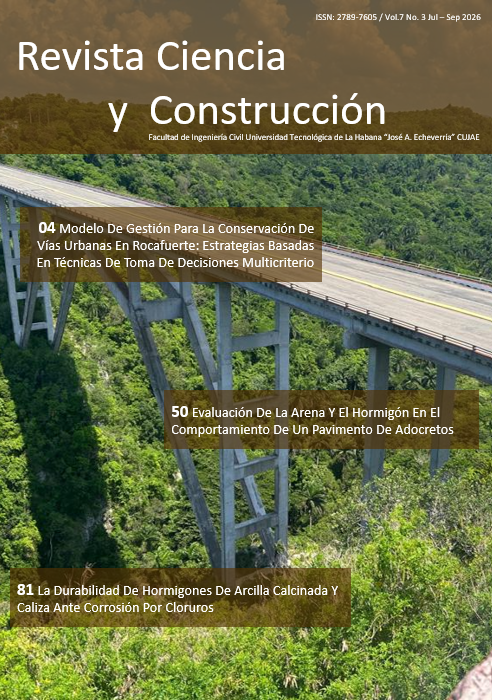
Durability of calcined clay and limestone concretes against chloride-induced corrosion
Keywords:
alcined clay, chlorides, corrosion, reinforced concreteAbstract
Portland cement production is one of the largest global sources of CO₂ emissions, which has driven the search for sustainable alternatives. Among these, limestone-calcined clay cement (LC3) emerges as a promising option, as it incorporates supplementary materials that significantly reduce clinker content. This review examines the influence of LC3 on the durability of concrete, with an emphasis on its resistance to chloride penetration—the primary cause of corrosion in structures exposed to marine environments. The mechanisms underlying the superior performance of LC3 are analyzed, including the refinement of the porous microstructure, the formation of chloride-binding phases (such as Friedel’s salt), and a reduction in ionic diffusivity. The review synthesizes experimental studies demonstrating that LC3-based concrete exhibits significantly lower chloride diffusion coefficients, higher electrical resistivity, and a greater capacity for chemical chloride binding compared to conventional Portland cement-based concrete, alongside lower corrosion rates for steel reinforcement. A notable drawback, however, is the lower critical chloride threshold value observed in LC3-based concrete compared to conventional concrete.
Downloads
Published
How to Cite
Issue
Section
License
The contents of this journal are under a Creative Commons Attribution-NonCommercial 3.0 Unported License, meaning that its copy and distribution are by all means allowed for as long proper acknowledgments are given and commercial use is not involved.